Managing multi-site maintenance is a strategic challenge for businesses. Given the wide range of equipment, the geographical distribution of sites and growing performance requirements, interventions can no longer be managed effectively using fragmented tools.
In this context, a CMMS (Computerised Maintenance Management System) has become an essential tool. It is much more than a simple monitoring tool: it structures, centralises and optimises all maintenance operations.
1. Complete centralisation of maintenance management
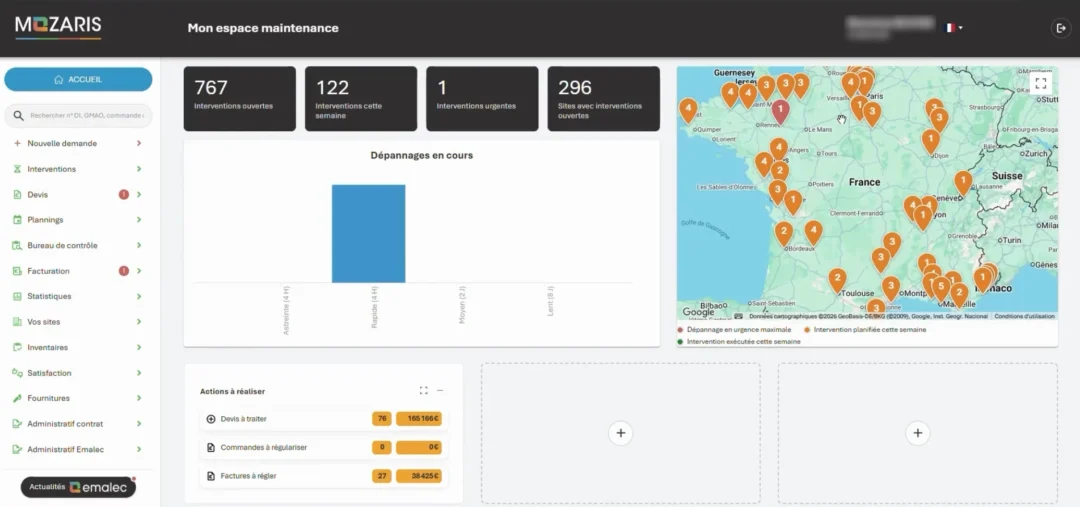
The primary benefit of a CMMS lies in its ability to centralise all maintenance data within a single platform. Interventions, equipment, records and resources are all accessible in real time.
For multi-site organisations, this centralisation is essential. It helps standardise practices, harmonise data and provide a comprehensive overview of the entire portfolio.
This is precisely the purpose of Emalec’s CMMS solution: to enable companies to manage all their interventions from a single tool, while simplifying day-to-day management and streamlining communication.
2. Improved intervention monitoring
A CMMS makes it possible to monitor each intervention accurately, from its creation through to completion. Every action is tracked, documented and stored in an accessible history.
This monitoring provides full transparency in maintenance management. It makes it possible to view the progress of interventions in real time, quickly identify bottlenecks and better coordinate teams.
CMMS solutions can also be used to manage preventive and corrective maintenance operations, while retaining a detailed history of equipment and breakdowns.
In the Emalec model, this traceability forms part of an overall management approach, in which each intervention is integrated into a comprehensive view of network performance.
3. A significant improvement in responsiveness
When an incident occurs, rapid response is essential. A CMMS centralises requests, assesses them and immediately directs them to the appropriate contacts.
This process reduces processing times and prevents information loss. Teams have access to a structured tool that enables them to respond more quickly and efficiently.
The CMMS therefore becomes a genuine intervention coordination tool, facilitating priority management and the flow of information.
4. Real-time performance management
Beyond operational management, a CMMS makes it possible to manage maintenance performance using precise indicators. Response times, resolution rates and breakdown frequency: this data can be used to analyse and optimise practices.
This analytical capability is now essential. It enables management teams to move from a reactive approach to a strategic management approach based on reliable indicators.
CMMS software includes dashboards and KPIs that make it possible to assess performance and guide decision-making.
The solution developed by Emalec is fully aligned with this approach, transforming intervention data into decision-making tools.
5. Optimised maintenance costs
A CMMS is also a tool for economic optimisation. By centralising data and analysing performance, it helps identify sources of costs and take appropriate action.
Companies can identify the most failure-prone equipment, detect recurring interventions and adjust their maintenance budgets.
More broadly, a CMMS helps reduce downtime and extend equipment lifespan, which has a direct impact on operating costs.
6. A shift towards more proactive maintenance
CMMS plays a key role in the development of maintenance strategies. By structuring data and facilitating its analysis, it enables the development of preventive and even predictive approaches.
Interventions can be scheduled according to the actual needs of the equipment, rather than systematically or reactively. This anticipation helps limit breakdowns and secure operations.
As part of the Emalec solution, the aim is to transform maintenance into a genuine performance driver.
7. Improved coordination among stakeholders
Finally, a CMMS improves coordination among all stakeholders: internal teams, field technicians, site managers and senior management.
It becomes a shared point of reference where everyone can access the necessary information, monitor ongoing actions and understand priorities.
In a multi-site environment, this coordination is essential to ensure consistency across interventions and prevent inefficiencies.